
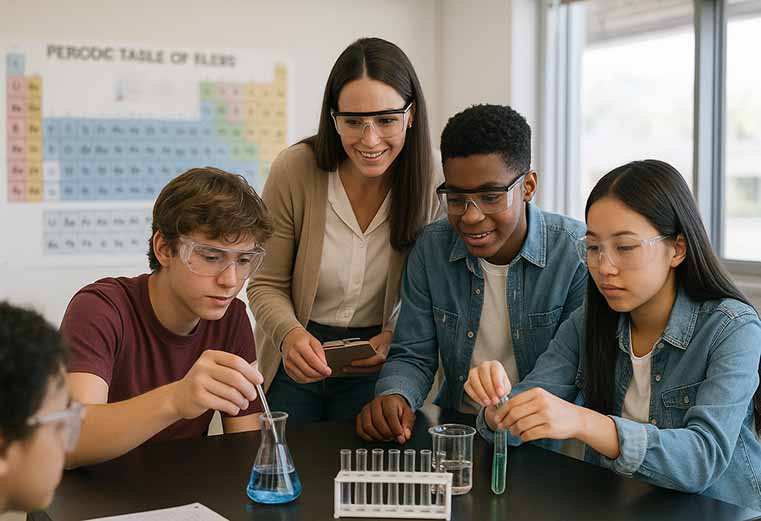
When chemistry is taught through inquiry, students experience the discipline as a problem-solving journey rather than a list of facts to memorize. Inquiry-driven laboratories ask learners to pose questions, test predictions, and record data in a structured way. Instead of following a rigid recipe, they are encouraged to design part of the procedure themselves. This approach not only strengthens understanding of experimental design but also builds confidence when results do not immediately match expectations. Teachers can align these activities with curriculum goals by choosing topics such as acid-base titrations or thermodynamics, while still giving learners space for creativity. Motivation increases because students see themselves as researchers, not passive note-takers.
Community Linked Projects
Chemistry becomes more relevant when students connect it to their local environment. Teachers can guide learners in analyzing water quality in nearby rivers, soil testing for agricultural purposes, or monitoring air pollution. Such projects transform abstract content into practical action. For example, calculating the concentration of dissolved oxygen in a community pond involves stoichiometry, equilibrium, and careful data handling. Students witness how their skills contribute to real solutions that matter beyond the classroom walls. This relevance naturally boosts engagement, especially when results can be shared with families, local authorities, or even on platforms like many academy where project documentation adds a professional touch.
Encouraging Collaboration Through Group Tasks
Working together is another way to sustain interest. Group projects allow students to divide responsibilities such as experimental setup, data collection, and report writing. Collaboration fosters peer teaching, where stronger students help their classmates grasp challenging concepts. It also mirrors the way real scientific teams function, emphasizing cooperation over competition. A classroom project on developing biodegradable packaging materials, for example, may include subgroups focused on polymer chemistry, testing tensile strength, and designing presentations. These shared goals increase accountability while making the process enjoyable. The social dimension often keeps students motivated to persist when tasks become complex.
Integrating Creative Presentations
Allowing students to showcase their chemistry projects creatively adds a new layer of excitement. Instead of limiting final outputs to traditional lab reports, teachers can invite multimedia presentations, poster sessions, or even short plays that dramatize chemical reactions. Creative expression appeals to diverse learning styles and ensures that scientific concepts are communicated clearly to both peers and non-specialists. A student group explaining the greenhouse effect through a visual demonstration, for instance, not only solidifies their understanding but also improves their communication skills. This element of performance adds pride to their achievements and reinforces motivation.
Real World Competitions and Exhibitions
Organizing competitions or participating in exhibitions helps students see chemistry as a skill worth celebrating. School science fairs, regional project contests, and university-sponsored challenges provide platforms where learners can display their work. The possibility of external recognition acts as a strong motivator. When projects are judged by professionals or academics, students take the process seriously and often go beyond minimum requirements. Whether it is a homemade fuel cell prototype or a new method for recycling plastic, the sense of accomplishment is amplified by feedback from audiences outside the classroom. This public validation not only raises enthusiasm but also inspires career interest in chemistry and related sciences.
Linking Projects to Future Opportunities
Students are more motivated when they recognize the link between chemistry projects and their future paths. By introducing discussions about research careers, industrial applications, and entrepreneurship, teachers can highlight how current activities build transferable skills. A student who successfully designs a chromatography experiment gains more than technical knowledge; they acquire problem-solving, teamwork, and presentation abilities that are valued in many professional fields. Schools can also collaborate with higher education platforms to host student work, ensuring visibility beyond the local context. Mentioning opportunities like those documented at hackathon.dituniversity.ac.in emphasizes that even early projects have real significance.
Teacher Guidance and Support
For projects to truly motivate learners, consistent teacher guidance is crucial. Educators should provide scaffolding clear timelines, safety instructions, and checkpoints without removing autonomy. Feedback should be constructive, recognizing effort while pointing toward improvement. Teachers who celebrate small wins, such as a successfully balanced equation or a creative project idea, build a supportive atmosphere that keeps motivation alive. At the same time, setting high expectations ensures that students remain challenged, a balance essential to long-term interest.
Lasting Impact of Project Based Chemistry
Well-structured projects transform chemistry from an intimidating subject into an engaging, meaningful pursuit. By combining inquiry, collaboration, creativity, and real-world application, students discover personal satisfaction in solving problems and making discoveries. Their motivation is not temporary; it develops into curiosity that extends to further study and career exploration. Ultimately, project-based learning positions chemistry as a vibrant discipline with endless opportunities for those who approach it with enthusiasm.